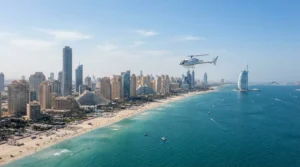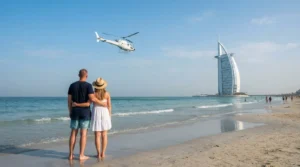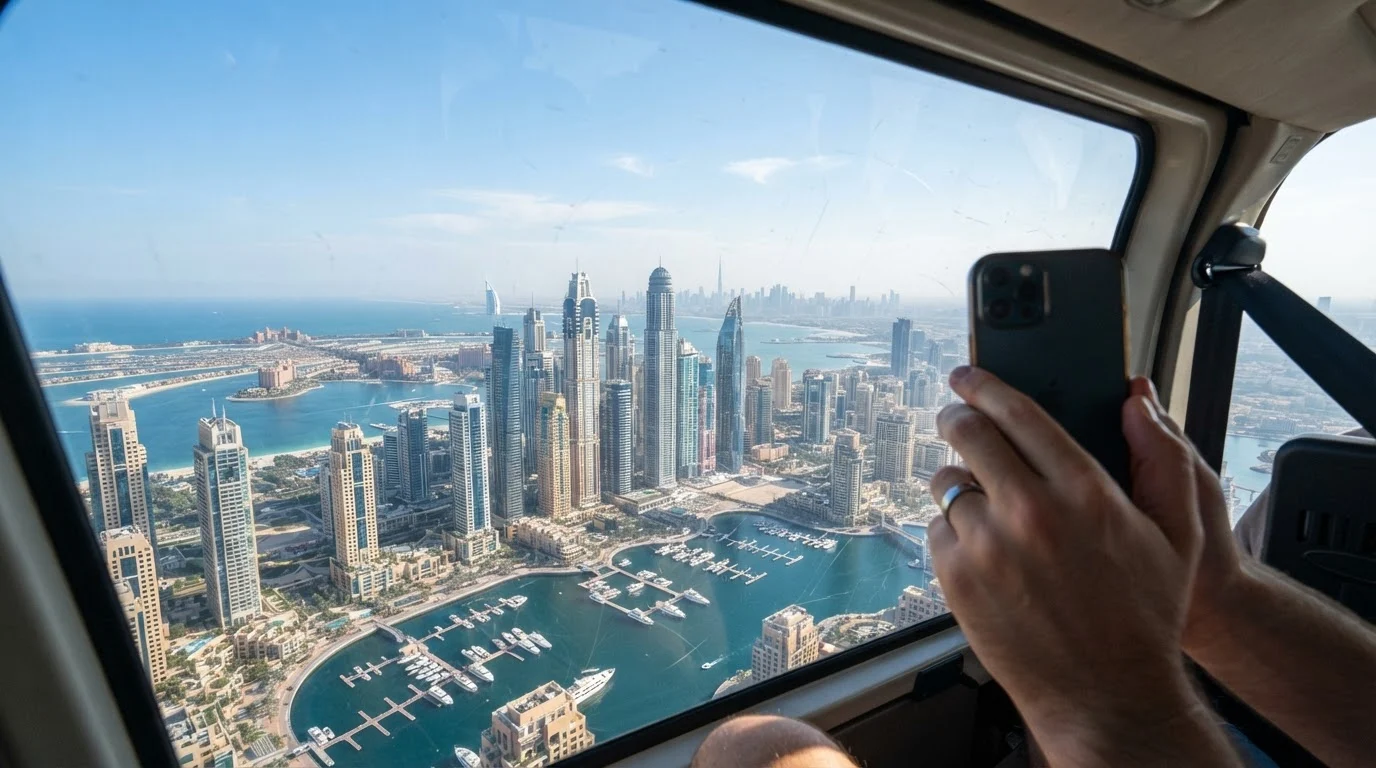
You can take photos on a Dubai helicopter ride once you are seated in the cabin, not while walking to or from the helicopter. For sharp shots, hold the lens close to the panoramic window, use a fast shutter, follow your route list and book one of three daytime windows: 9:00 to 11:00, 12:30 to 14:30 or 15:10 to 17:00.
Key takeaways
- Photos are taken once you are seated in the cabin, never while walking to or from the helicopter.
- Every tour has an air-conditioned cabin, large panoramic windows and noise-cancelling headsets for the pilot's commentary.
- The booking form offers three daytime windows: 9:00 to 11:00, 12:30 to 14:30 and 15:10 to 17:00. None is a sunset or night flight.
- Window glare spoils more shots than anything else. A dark top, a lens close to the glass, no flash and a dimmed screen all help.
- No seat or side of the helicopter can be promised. A private flight gives your group of up to 5 guests the whole helicopter.
- For straps, selfie sticks, drones or bulky camera bags, ask the team before you pack them.
Can you take photos on a helicopter ride in Dubai?
Yes. Helicopter Ride Dubai's passenger rules allow photos once you are seated inside the cabin, and they are just as clear about the opposite case: no photos while you walk out to the helicopter or back from it after landing. Keep your phone or camera away for those few minutes, follow the directions of the staff on the ground, and take it out again once you are in your seat.
Every tour includes a pre-flight safety briefing. Listen closely. If it covers how to hold or stow a phone or camera, those instructions come before anything in this guide.
The cabin is air-conditioned and has large panoramic windows, so every tip below assumes glass between your lens and the city. If you have a question about opening a window, or about any gear beyond a phone or a handheld camera, ask the team before the day rather than at check-in.
Hazardous materials, explosives, weapons, flammable liquids, food and drinks are not allowed on board. Pack your camera kit with that list in mind.
Phone or camera: which works better through a helicopter window?
Both work well. The right choice depends on how you already take pictures and how much you want to carry.
The case for a phone
A modern phone is light, quick to raise and good at balancing a bright sky against darker streets. Most phones have a main camera, often labelled 1x, and an ultra-wide, often labelled 0.5x. The main camera gives the most natural look for towers. The ultra-wide fits more in but bends straight lines near the edges, which can make tall buildings lean, so save it for wide coastline views.
Digital zoom past the phone's longest built-in lens loses detail quickly. Frame with the lens you have and crop a little later if you need to.
The case for a camera
A mirrorless or DSLR camera gives you more control over shutter speed and more detail for printing or cropping. A standard zoom that runs from wide angle to short telephoto covers most of what you see from the window. Very long lenses are hard to hold steady in a moving aircraft and magnify every bit of vibration.
Keep it simple. One body and one lens is easier than swapping lenses in the air, and a lens change on a 12 or 15-minute route can cost you a landmark. Whether your phone or camera should be on a strap is a question for the team, so ask when you book.
How do you stop window glare and reflections?
Glare and reflections ruin more aerial photos than any other problem. The window reflects whatever is behind your lens: your clothes, your screen and the inside of the cabin.
Get close to the glass
Hold the lens close to the window and as square to it as you can. The closer the lens, the less room reflections have to creep in from the side. Shooting at a sharp angle through glass also adds distortion, so turn your body towards the subject rather than twisting only the phone.
Use a rubber lens hood or your hand
A soft rubber lens hood lets you rest a camera lens gently against the glass, blocking stray light and absorbing some vibration. Without one, hold the lens just off the glass so vibration does not pass straight into the camera. On a phone, cup your free hand around the lens.
Dress for the window
Light or patterned clothing shows up as ghost shapes in the glass, while dark, plain tops reflect far less. The guide on what to wear on a helicopter ride in Dubai covers clothing for the whole day.
Flash off, screen dimmed, lens clean
A flash fired at a window lights up the glass, not the city, so turn it off before you board. A bright phone screen can appear as a pale rectangle in the window, so lower the brightness once seated. Clean your own lens with a microfibre cloth before take-off, and if a fingerprint on the inside of the window sits in your frame, a gentle wipe can help. Marks on the outside are beyond your reach, so shift your framing to keep them out.
Know what is coming: your route list and the pilot's commentary
Good aerial photographers know the next shot before it arrives. On a Dubai helicopter tour you have two tools for that: the route list for your tour and the pilot's commentary through your headset.
Each tour page lists the landmarks a flight typically passes. Routes adjust with weather and air traffic, so treat the list as a guide rather than a fixed running order, and read it the night before.
| Route | Flight time | Shared seat | Private flight (up to 5 guests) | Landmarks the route typically passes |
|---|---|---|---|---|
| City Scapes | 12 minutes | AED 715 per person | AED 3,145 per aircraft | Burj Khalifa, Burj Al Arab, Dubai Coastline, The Palm Jumeirah, Downtown Dubai |
| Fun Ride | 15 minutes | AED 921 per person | AED 4,041 per aircraft | Burj Khalifa, Aquaventure Waterpark, Burj Al Arab, Jumeirah Beach Coastline, The World Islands, Business Bay |
| The Iconic Tour | 17 minutes | AED 979 per person | AED 4,525 per aircraft | Atlantis The Palm, Burj Al Arab, Burj Khalifa, Dubai Coastline, Downtown Dubai, Business Bay, The Lagoon Project |
| City Circuit | 25 minutes | AED 1,450 per person | AED 6,353 per aircraft | The World Islands, Burj Khalifa, Sheikh Zayed Road, Dubai Creek, Port Rashid, Dubai Internet City, Jumeirah Lake Towers, Dubai Marina |
| The Imperial Tour | 40 minutes | Private flight only | AED 11,463 per aircraft | Jebel Ali Port, Palm Jebel Ali, Ski Dubai, Burj Al Arab, Kite Beach, Dubai Canal, Burj Khalifa, Dubai Creek, Dubai Frame |
| The Gulf Desert Tour | 60 minutes | Private flight only | AED 15,593 per aircraft | Palm Jumeirah, World Islands, Burj Khalifa, Dubai Creek, Dubai Frame, Dubai Marina, Palm Jebel Ali, covering city, coast and desert |
If Dubai Marina is the picture you want, two route lists name it: City Circuit and The Gulf Desert Tour. For a full side-by-side look at all six, see the Dubai helicopter tours comparison.
Let the commentary set your timing
When the pilot mentions a landmark ahead, treat it as your cue. Raise the phone or camera and start shooting before the landmark is beside you, then keep going as it passes. Shooting early gives you more frames and more chances to catch one without glare.
Which booking window is best for photos?
The booking form offers three windows: 9:00 to 11:00, 12:30 to 14:30 and 15:10 to 17:00. All three are daytime windows, and the form does not sell sunrise, sunset or night flights. What follows are general photography patterns, not promises about any one day.
Morning: 9:00 to 11:00
The morning sun sits lower than at midday. Light arriving at an angle throws shadows that give buildings shape and help the outline of a palm island stand out against the water. If you like depth and texture, the morning window is a sensible choice.
Midday: 12:30 to 14:30
At midday the sun is high, shadows are short and colours look bright. The trade-off is contrast: bright rooftops and dark streets in the same frame. Tap to set exposure on the brightest part of the scene so the sky and pale buildings keep their detail.
Afternoon: 15:10 to 17:00
In the afternoon window the sun drops lower again and shadows return. It is still a daytime window, not a sunset flight, but the angle of the light brings back texture that midday flattens.
Haze and the time of year
Haze affects aerial photos more than any camera setting. It softens distant towers and turns the horizon pale, and how much you meet depends on the weather and the season, not only the window. The post on the best time of year for a helicopter ride in Dubai looks at the seasons in detail.
On a hazy day, shoot down rather than out towards the horizon. Patterns on the ground, such as the fronds of a palm island or the clusters of The World Islands, stay sharper than a distant skyline.
Book at least 2 days ahead, and earlier in peak season. If one window matters for your photos, book early so it is more likely to be open.
Can you choose a window seat or a side of the helicopter?
Do not build your plan around a particular seat or side. This guide cannot promise either, and on a shared flight you sit with other guests. If seating matters to you, ask the team before you book.
Landmarks can appear on either side during a flight, and the commentary helps you look in the right direction. Some of the strongest aerial shots come from looking down at patterns below, which works from any window.
A private flight gives your group the whole cabin
A private flight books the whole helicopter for your group of up to 5 guests, so the windows are shared only within your group. On the four shared routes, a private flight costs less than five shared seats, as the private column in the table above shows. The Imperial Tour and The Gulf Desert Tour are sold as private flights only.
With your own group on board, agree a plan before take-off. One person films video while another takes stills, so nobody misses a view by switching modes, and everyone leaves with a picture of themselves in the cabin.
Phone settings that help over Dubai
Set your phone up before you leave. Once you are seated, there is no time to search through menus.
- Clean the lens. A thumbprint softens every frame.
- Switch the flash off. It only reflects off the window.
- Use the main camera for towers. Keep the ultra-wide for broad coastal views.
- Use burst mode. Vibration blurs some frames, and a burst gives you sharp ones to pick from.
- Lock focus and exposure. Tap and hold on the landmark so the phone stops refocusing on the window.
- Leave HDR on automatic. It balances a bright sky against darker streets.
- Turn on grid lines. They help keep the horizon level.
- Free up storage and charge fully. Video fills storage fast.
Shooting video
Hold the phone in landscape orientation and switch on stabilisation if your phone has it. Move slowly and let the helicopter do most of the moving. Hold each scene for a few seconds before you pan away, because short, jerky clips are hard to use later.
Camera settings for shooting through helicopter glass
If you bring a camera, these general settings are a good starting point.
- Shutter speed: use shutter priority at 1/1000 second or faster. Vibration and movement cause most soft aerial pictures, so go faster if early shots look soft.
- ISO: automatic. In daylight it should stay low.
- Aperture: a middle aperture such as f/5.6 to f/8 gives good sharpness across the frame.
- Focus: use a single focus point on the landmark, so autofocus does not lock onto marks on the window.
- Stabilisation: keep it switched on.
- File type: shoot RAW, or RAW with JPEG, for more room to correct haze and colour later.
- Exposure: white buildings and bright sea can fool the meter, so check the histogram on an early frame.
Take a few test frames as soon as you are seated, and check one for reflections before the first landmark arrives.
Composition: what makes an aerial Dubai photo work
Good settings give you a sharp picture. Composition makes it worth looking at.
Look down as well as out
From the air you see shapes that are invisible from the ground. The fronds and crescent of The Palm Jumeirah, the clusters of The World Islands and the curve of Dubai Creek all read best when you look down at them.
Use lines to lead the eye
Sheikh Zayed Road, on the City Circuit route list, runs through the city with towers on both sides. The Dubai Coastline on City Scapes and The Iconic Tour draws a clean edge between land and sea. Place a line so it runs from a corner of the frame towards your subject.
Show height with an angle
Towers seen from directly above look flat. Shoot them at an angle so their sides show, with something lower nearby for scale. Burj Khalifa is on every route list, so it is a good subject for trying more than one angle.
Keep the horizon level, and include the cabin now and then
A tilted horizon is the most common flaw in aerial photos, so use grid lines and straighten anything that slipped when you edit. Also take a few frames that show the edge of the window, or a hand holding a phone to the glass. They tell the story of being in a helicopter, and friends often remember them most.
A photography checklist for the day
Before you leave
- Read your tour's route list, charge your phone or camera, free up storage and clean the lens.
- Wear a dark, plain top, and leave food and drinks behind.
- Ask the team about straps, selfie sticks, drones, bulky camera bags or anything else you are unsure of.
At the heliport
- Tours fly from Dubai heliports including Atlantis, The Palm, and the meeting point is emailed after booking. The optional Private Pickup and Dropoff costs AED 450 per car for 5 to 6 guests and collects you 1 hour before the flight time.
- Check in at least 45 minutes before departure. The company is not accountable for latecomers and may release the flight as planned.
- Keep your phone or camera away while you walk to the helicopter.
In the air and after landing
- Once seated, bring out your phone or camera, listen for the commentary, and check an early frame for glare.
- Put the camera down for a moment and simply look. The view is the reason you came.
- Put everything away again before you walk back from the helicopter.
What happens if the weather spoils the view?
Routes adjust with weather and air traffic, so the landmarks on your list are typical rather than fixed. If Helicopter Ride Dubai cancels a flight for bad weather or a technical issue, guests hear by phone or email and get a 100% refund or a reschedule at no extra cost. Refunds reach a bank account within 7 working days.
If you decide to cancel yourself, perhaps because the forecast looks hazy, the guest cancellation terms apply: a 100% refund if cancelled more than 96 hours before departure, a 50% refund from 48 to 96 hours before, and no refund less than 48 hours before. Weigh the forecast against those deadlines before you change your plans.
After the flight: getting the most from your photos
Back up your pictures the same day. Bursts leave you with many near-identical frames, so keep the sharpest from each and delete the rest.
Edit lightly. Straighten the horizon, crop out any reflection near the edges and add a touch of contrast. A dehaze control can bring back distant towers, but stop before the sky turns grey or the colours look unreal. For framing ideas, browse the gallery of Dubai from above and look for the same shots on your next flight.
Plan your photo flight
A Dubai helicopter ride shows you a city the ground cannot. Your photos depend on a few habits: shoot only once seated, keep the lens close to the glass, use a fast shutter, follow the route list and pick the daytime window whose light suits you. Choose your route, a shared seat or a private flight and your time window on the Helicopter Ride Dubai booking form, or call or WhatsApp the team on +971 52 590 6075 with any questions about your camera gear.